

Whether you are looking to shave strokes off your game at the local country club, zip around a sprawling retirement community, or haul gear across a rugged farm property, buying a golf cart is a significant investment. One of the first and most critical decisions you will face is a classic mechanical crossroads: Electric or Gas?
Both power sources have evolved tremendously over the last decade. The “noisy, smelly” gas carts of the past have been replaced by high-efficiency EFI (Electronic Fuel Injection) engines, while the “weak, short-range” electric carts have been revolutionized by Lithium-ion technology.
At Golf Cart Guy Gap PA, we’ve seen every side of this debate. As the premier destination for sales, service, and custom builds in Lancaster County, our team specializes in helping customers navigate these specs to find the perfect fit. From brand-new models to expertly refurbished used carts, Golf Cart Guy Gap PA is your local authority on all things mobile.
We will break down the pros, cons, and “hidden” factors of both electric and gas carts to help you decide which one deserves a spot in your garage.
Electric Golf Carts: The Silent Powerhouse
Electric golf carts in Reading, PA have become the industry standard for most recreational users. Powered by a bank of deep-cycle batteries and an electric motor, these carts offer a smooth, environmentally friendly ride.
The Pros of Electric
- The Power of Voltage: If you need to tow a trailer, haul a bed full of stone, or climb the steep hills of Lancaster County, a 48V or 72V electric cart is often better than gas. Higher voltage provides massive low-end torque, giving you the “grunt” needed to start a heavy load on an incline without the engine struggling to find its power band.
- Quiet Operation: This is the most immediate benefit. Electric carts move with a nearly silent hum. This is ideal for early-morning tee times where you don’t want to wake the neighbors, or for hunting trips where stealth is a priority.
- Lower Maintenance: Because an electric motor has significantly fewer moving parts than a combustion engine, there is less that can go wrong. You don’t have to worry about oil changes, spark plugs, air filters, or fuel pumps.
- Eco-Friendly: With zero tailpipe emissions, electric carts are the “green” choice. Many indoor facilities or strict gated communities actually require electric carts for this reason.
- Smooth Acceleration: Electric motors provide “instant torque,” meaning you get smooth, consistent power the moment you step on the pedal.
The Cons of Electric
- Charging Time: Unlike a gas tank you can fill in two minutes, an electric cart needs to be plugged in. Depending on the charger and battery type, a full charge can take anywhere from 4 to 10 hours.
- Limited Range: While modern batteries are impressive, you still have a “fuel tank” that eventually runs dry. If you are miles away from a power outlet when the battery hits zero, you are stranded.
- Battery Replacement Costs: Every few years (typically 5–7 for lead-acid), you will need to replace the entire battery bank. This can be a significant upfront expense.
Gas Golf Carts: The Long-Distance Runner
Gas-powered carts are essentially small cars. They utilize 4-stroke engines (similar to a lawnmower or small motorcycle) and offer a level of independence that electric carts can’t quite match.
The Pros of Gas
- Unlimited Range: As long as you have a gas can nearby, you can keep driving. This makes gas carts the superior choice for all-day events, large farms, or industrial job sites where the cart is in constant motion.
- Higher Power for Heavy Loads: Gas engines generally handle steep hills and heavy towing better than entry-level electric models. If you’re hauling a trailer full of mulch or driving through muddy trails, gas is often the way to go.
- Ease of “Refueling”: You don’t need a specialized charging station. Any standard gas station provides the fuel you need to get back on the road in minutes.
The Cons of Gas
- Noise and Vibration: Even the quietest gas carts produce noise and a slight vibration through the floorboard. In quiet residential areas, this can be a nuisance.
- Ongoing Maintenance: You are essentially maintaining a small vehicle. You’ll need regular oil changes, belt replacements, and tune-ups to keep the engine running smoothly.
- Emissions: Gas carts produce exhaust fumes. They cannot be used in enclosed spaces and are less environmentally friendly than their electric counterparts.
The New Contender: Lithium-Ion Electric Carts
If you are leaning toward electric but are worried about the “cons” listed above, you need to talk to the team at Golf Cart Guy Gap PA about Lithium-ion technology.
Lithium batteries have changed the game. They are lighter (improving the cart’s speed and handling), they charge significantly faster, and they require zero maintenance (no more filling battery cells with distilled water). Best of all, they typically last 10 years or more. While the initial cost is higher, the “life-cycle” cost often beats out both traditional lead-acid electric and gas carts.
Maintenance Requirements: What to Expect
At Golf Cart Guy Gap PA, we don’t just sell carts; we keep them running for years. Understanding the maintenance “personality” of your cart is vital.
Electric Maintenance Checklist:
- Watering: 48V/72V Lead-Acid batteries requires monthly watering (distilled water) and terminal cleaning.
- Cleaning Terminals: Battery acid can cause corrosion on the cables. Regular cleaning maintains a strong connection.
- Tire Pressure: To maximize your range per charge, keep your tires at the recommended PSI.
Gas Maintenance Checklist:
- Oil Changes: Usually required once a year or every 100 hours of use.
- Air and Fuel Filters: These need to be checked and replaced to prevent engine “sputtering.”
- Spark Plugs: A clean spark plug makes sure the cart starts reliably every time.
Which One Is Right for Your Geography?
Your location in Pennsylvania can actually dictate which cart you should buy.
- Flat Terrain (The Villages, Paved Subdivisions): An electric cart is perfect here. You don’t need the raw “climbing” torque of a gas engine, and the quiet operation will be appreciated by your neighbors.
- Hilly Terrain (Rural Lancaster County, Wooded Trails): If your property has significant elevation changes, a gas cart or a high-voltage (48V or 72V) electric cart with an upgraded motor is necessary. Standard 36V electric carts may struggle on steep inclines.
- Cold Weather Storage: If you leave your cart in an unheated shed over a Pennsylvania winter, gas carts are generally easier to “wake up” in the spring. Electric batteries can lose significant life if they are allowed to freeze while discharged.
Golf Cart Expertise in Gap, PA
Choosing between gas and electric isn’t just about reading a spec sheet; it’s about how the cart feels and how it fits into your daily routine. That is why working with a local expert like Golf Cart Guy Gap PA is so important.
Customization Services
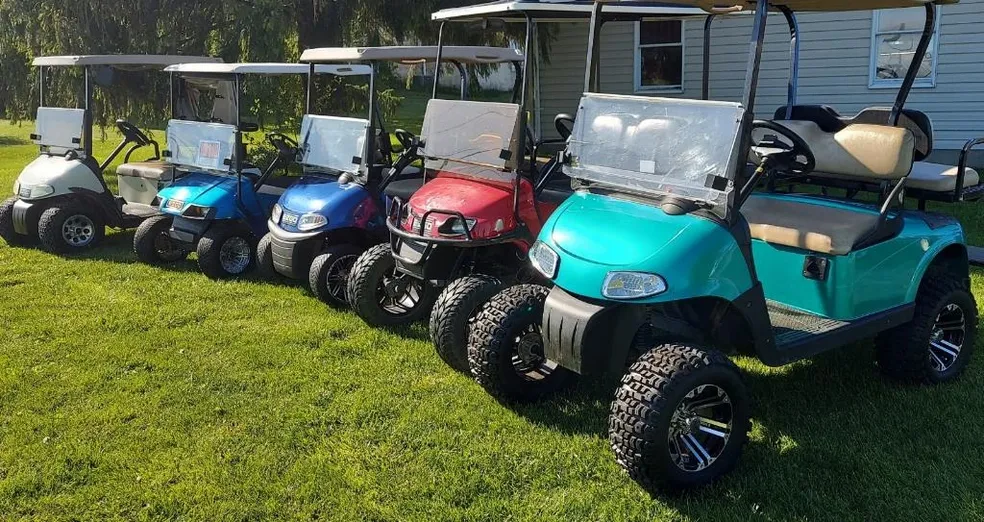
Whether you choose gas or electric, we can customize your ride. From lift kits and aggressive off-road tires to custom paint jobs, LED light kits, and rear-flip seats, we turn standard carts into personalized vehicles.
Trusted Service and Parts
If your gas engine starts acting up or your electric cart isn’t holding a charge like it used to, our Gap, PA service center is equipped to handle the repair. We stock a wide array of parts for major brands like E-Z-GO, Club Car, and Yamaha.
Refurbished Options
Not ready to buy brand new? We specialize in high-quality refurbished carts, and we have a wide selection of used golf carts for sale in PA. Our technicians go through these carts with a fine-tooth comb, making sure that whether it’s a gas engine or an electric motor, it meets our rigorous standards for safety and performance before it hits the sales floor.
Cost Analysis: Short-Term vs. Long-Term
- Initial Purchase Price: Generally, a used gas cart is slightly more expensive than a used lead-acid electric cart. However, a new Lithium-ion electric cart is typically the most expensive upfront.
- Operating Costs: Electric is significantly cheaper to “refuel” (pennies on the dollar in electricity vs. gallons of gas).
- Resale Value: Both gas and electric carts hold their value remarkably well if they are maintained. Gas carts often have a slight edge in the used market for rural buyers, while electric is king in suburban and golfing communities.
The Final Verdict
So, which one wins?
- Choose Electric if: You want a quiet, low-maintenance ride for short to medium distances, and you have easy access to a power outlet in your garage or shed.
- Choose Gas if: You have a large property, you plan to use the cart for work/hauling, or you don’t want to be tied to a charging cable.
Still not sure? The best way to decide is to see them in person. At Golf Cart Guy Gap PA, we invite you to visit our showroom, ask our experts your toughest questions, and even take a test drive. We pride ourselves on transparent service and helping our neighbors find the ride that makes their life easier and more fun.
Ready to find your perfect cart? Check out our current inventory or stop by our shop in Gap, PA today. Whether it’s gas, electric, or custom-built, we’ll get you rolling in style. Contact us today to get started!