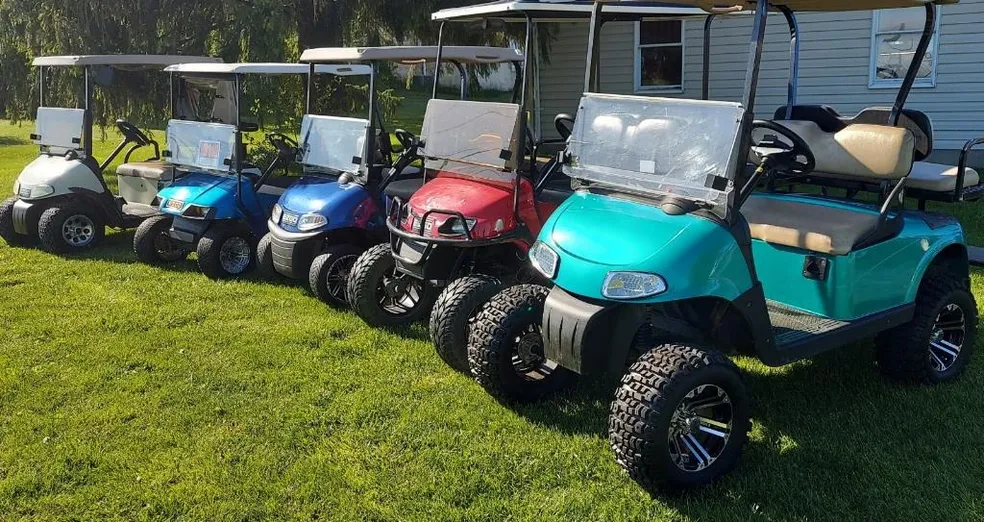


Most buyers get the decision right by answering four questions in order: how many people ride regularly, what surface you drive on, whether the cart needs to be street legal, and what you want to spend over the next five years. Everything else, including color, wheels and sound systems, is adjustable later. This 2026 golf cart buyer’s guide walks through each decision with real numbers so you can walk into a dealership already knowing which two or three models actually fit.
Start With Where the Cart Will Spend Its Life
A cart that lives on flat cart paths and a cart that climbs a gravel driveway in Chester County are built differently, even if they look nearly identical on the showroom floor. Terrain drives your motor size, tire choice and suspension more than any other factor.
- Paved neighborhoods and cart paths: a standard-height cart on turf or street tires, 4 to 5 horsepower equivalent, is plenty.
- Gravel lanes, grass fields and mild hills: look for a higher-torque motor and at least an 8-inch lift with all-terrain tires.
- Farm or property work: prioritize payload rating and a rear cargo bed over seating, and check the rated towing capacity.
- Campgrounds and shore communities: local speed and lighting rules usually matter more than power.
Hill grade is the detail people underestimate. A loaded six-passenger cart on a 12 percent grade pulls far more current than the same cart on level ground, which shortens range and heats the controller.
Electric or Gas in 2026
Electric carts now make up the large majority of new consumer sales, and lithium has taken over the electric side. A 48-volt or 72-volt lithium cart typically delivers 30 to 45 miles of range, charges in 4 to 6 hours, and needs no watering, no terminal cleaning and no equalizing charge.
Gas still wins in specific cases: long workdays with no charging access, heavy towing, and remote properties where a five-gallon can is easier than running a 110-volt circuit to the shed. The tradeoff is noise, exhaust and routine oil changes every 100 to 125 hours. If you lean that direction, our breakdown of where to buy a gas golf cart covers what to inspect on used engines.
Battery math matters at resale. A lead-acid pack usually needs replacing at 4 to 6 years for roughly $900 to $1,600 installed, while lithium packs commonly carry 8-year warranties and run $1,800 to $3,500 to replace.
Seating: Two, Four or Six Passengers
Buyers almost never regret going one row larger, and they frequently regret going smaller. Think about the busiest realistic trip, not the average one.
- Two-passenger: shortest wheelbase, easiest to store in a single-bay garage, best for couples and course play.
- Four-passenger with rear flip seat: the most popular setup, since the back seat folds into a cargo deck for mulch bags or coolers.
- Six-passenger: roughly 11 to 13 feet long, noticeably wider turning radius, and the right call for families or rental use.
Measure your garage depth before you commit. A six-passenger cart will not clear a typical 20-foot bay once you add a rear seat kit and a bumper.
Lifted Versus Standard Ride Height
A 6-inch lift with 14-inch wheels looks great and clears ruts, but it raises the center of gravity and makes the cart tippier in sharp turns. Standard height carts ride lower, corner flatter and cost less to maintain because the steering geometry stays factory. We compared the handling differences in detail in our article on lifted versus standard ride height.
If you lift, keep tire diameter reasonable. Jumping from 20-inch to 23-inch tires without a controller or gear change can drop low-end torque and add strain on the drivetrain.
We cover this topic in more depth in The Ultimate 2026 Golf Cart Buyer’s Guide: How to Pick the Perfect Ride.
Street-Legal Rules You Should Check Before Buying
A standard golf cart tops out near 15 mph and is not legal on public roads. A low-speed vehicle (LSV) is a different classification: it must reach 20 to 25 mph and carry headlights, taillights, turn signals, mirrors, a windshield, seat belts and a VIN under federal standard FMVSS 500.
Pennsylvania treats LSVs as registrable vehicles requiring title, registration and insurance, and local borough ordinances can further restrict which roads you may use. Check posted speed limits first, because most states cap LSV road use at streets rated 35 mph or lower. Current titling rules are published by PennDOT, and Delaware and Maryland handle the paperwork somewhat differently.
What Golf Carts Actually Cost in 2026
Pricing has settled after several volatile years, though lithium packs and street-legal packages still push the top end higher. These ranges reflect typical dealer pricing in the mid-Atlantic, before tax and delivery.
- New four-passenger electric, lithium: roughly $9,500 to $14,500 depending on brand and trim.
- New six-passenger electric: about $13,000 to $19,000.
- New street-legal LSV package: add $1,200 to $2,500 over the base cart.
- Reconditioned pre-owned carts: commonly $5,000 to $9,000 with a fresh battery pack.
- Older project carts sold privately: $2,000 to $4,000, usually needing batteries or tires.
Factor ownership cost, not just sticker price. Annual maintenance on an electric cart typically runs $150 to $300 for brakes, tires and a controller check, while gas carts add oil, filters and belts.
New Versus Pre-Owned
New carts give you a warranty (commonly 2 to 5 years on major components, longer on lithium), current safety equipment and the ability to spec exactly what you want. Pre-owned carts save 30 to 45 percent, and a well-reconditioned four-year-old cart from a dealer often has a newer battery pack than its age suggests.
Private-party sales carry the most risk. Ask for the serial number, check the charge cycle count on lithium models, and test drive up the steepest hill nearby with a full load of passengers.
Accessories Worth Adding at Purchase
Bundling accessories into the original build usually costs less than retrofitting, since the cart is already apart on the lift. The items buyers add most often within the first year:
- Rear flip seat with grab bar for extra passengers and cargo flexibility.
- Folding or tinted windshield for wind, rain and road debris.
- Enclosure or rain cover to extend the season into November and March.
- Brush guard and heavy-duty rear bumper if you drive on wooded property.
- USB charging ports and LED light kit for evening driving.
Questions to Ask Any Dealer Before You Sign
Service capability separates dealers more than price does. A cart you cannot get repaired locally becomes an expensive lawn ornament the first time a controller fails.
- Who performs warranty work, and is it done in-house or shipped out?
- What is the typical turnaround on a common repair in July?
- Do you stock parts for this brand, or order them per job?
- Is the battery warranty prorated, and what voids it?
- Do you offer pickup and delivery for service?
Buyers in southern Chester County often start at our golf cart showroom, while shoppers farther west compare inventory for new carts in Honey Brook or browse new and used models in Morgantown.
Talk Through Your Options Before You Buy
Bring your terrain, passenger count and budget to the conversation and the right two or three models usually become obvious within ten minutes. Jason Burke can set up a test drive on the hills you actually plan to climb and price out the accessories that make sense for your property. Contact us today!