
A standard golf cart typically sits with 4 to 5 inches of ground clearance on 8-inch wheels, while a lifted cart riding on a 6-inch kit and 23-inch tires usually clears 9 to 11 inches. That difference changes almost everything about how the vehicle drives, where it fits, and what it costs to own.
Neither setup is objectively better. The right choice depends on terrain, storage height, who rides along, and how fast the cart will be driven on a regular route.
What Lifted and Standard Actually Mean on a Spec Sheet
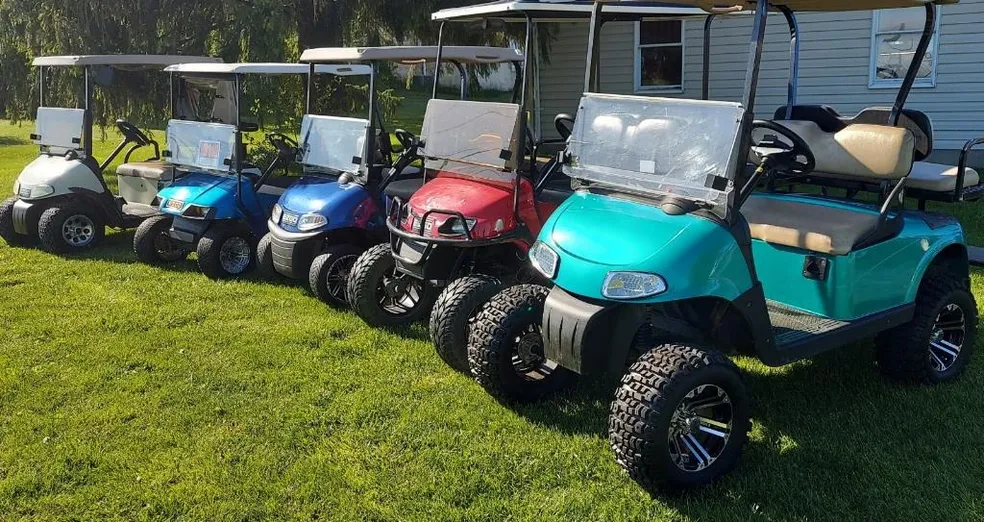
A standard ride height cart leaves the factory with its original suspension geometry, 8-inch or 10-inch wheels, and an overall roof height around 68 to 72 inches. A lifted cart uses either a spindle lift, a drop-axle kit, or a full A-arm kit, most commonly rated at 3, 4, or 6 inches.
Tire diameter stacks on top of the kit number. Moving from a 18-inch tire to a 23-inch tire adds roughly 2.5 inches of axle height on its own, so a 4-inch kit with larger tires can raise the body closer to 6.5 inches total.
- Spindle or block lift (2 to 3 inches): least expensive, keeps most factory geometry, modest clearance gain.
- Drop-axle lift (4 to 5 inches): the common middle ground on new lifted carts, with wider track width.
- A-arm lift (6 inches and up): longer travel, better articulation over ruts, highest center of gravity.
Ground Clearance That Matters on Real Ground
Clearance only becomes a selling point when the terrain demands it. Mowed lawn, crushed stone driveways and asphalt paths rarely challenge a standard cart, and plenty of owners drive 2,000 miles a year without scraping anything.
Field edges, frost-heaved farm lanes, creek crossings and rutted tree lines are a different story. A lifted cart with 23-inch knobby tires will clear a 7-inch rut that drags the frame rails of a stock cart, and the larger contact patch floats better over soft spring ground.
Breakover angle matters as much as static clearance. Longer six-passenger models sit on a stretched wheelbase, so the midpoint of the frame hits a crown or berm before the axles do, which is one reason lifted six-seaters are so common on acreage.
Garage Doors, Carports and Trailer Height
Most residential garage doors measure 84 inches of clear opening, which leaves room for either configuration. Problems show up with older bank barns, carports, and sheds, where openings of 78 to 80 inches are common.
Measure the opening before adding anything to the roof. A rear flip seat with a cargo rack, a light bar, or a fold-down windshield left upright can each add 2 to 6 inches to the tallest point of a lifted cart.
- Standard cart with roof: roughly 68 to 72 inches overall.
- Lifted cart with roof: roughly 76 to 82 inches depending on kit and tire size.
- Enclosed trailer clearance: verify interior height, since many 7-foot trailers lose 4 inches to frame rails and lighting.
Handling Differences Owners Feel in the First Mile
Raising the body raises the center of gravity by nearly the full lift amount, and that shifts how the cart behaves in corners. A lifted cart leans more through a turn, takes longer to settle after a bump, and feels noticeably taller at speed on pavement.
Standard ride height carts corner flatter, track straighter on cart paths, and feel more planted when loaded with four adults. Golf cart rollovers and ejections are a documented injury source tracked by the U.S. Consumer Product Safety Commission, and most incidents involve sharp turns at higher speeds rather than rough terrain.
Practical guidance for lifted carts: slow to under 10 mph before turning, keep passengers seated with hands inside, and avoid side-hilling on slopes steeper than about 15 degrees. Those habits matter less on a stock cart but still apply.
Range, Speed and Drivetrain Load
Taller tires act like taller gearing. A 23-inch tire on a cart designed around an 18-inch tire raises effective gearing by roughly 20 percent, which trims low-end torque, adds a few tenths to 0 to 15 mph acceleration, and can push the indicated speedometer reading off by 5 to 8 percent.
Expect a lifted setup with aggressive tires to give up 5 to 12 percent of range compared to the same cart on stock wheels. Hilly routes widen that gap because the motor spends more time under load, which is worth factoring into battery and pack size decisions.
Street-legal buyers have another constraint. Low-speed vehicles built to FMVSS 571.500 must stay within a 20 to 25 mph top speed window, so gearing changes from oversized tires need to be checked rather than assumed.
Ride Comfort Over Gravel Versus Pavement
Lifted carts usually pair the kit with longer shocks and, on several brands, independent front suspension that soaks up washboard gravel better than a stock leaf-spring setup. Over a quarter-mile stone lane, the difference is obvious.
On smooth asphalt, the advantage reverses. Taller sidewalls and softer springs introduce a floaty motion that some passengers dislike, particularly older riders and anyone prone to motion sensitivity.
What Each Setup Costs
Factory lifted trims generally run $800 to $1,800 above the equivalent standard model, and that figure usually includes larger wheels and tires. Adding a lift later costs more for the same result.
- Aftermarket 4-inch kit installed: commonly $600 to $1,200 depending on model and kit type.
- 6-inch A-arm kit installed: often $1,000 to $2,000.
- Wheel and tire package: $600 to $1,400 for a 14-inch wheel with a 23-inch tire.
- Ongoing wear: ball joints, tie rod ends, and bushings see higher loads, so budget inspections every 12 months.
Alignment is the item buyers forget. A lifted cart that pulls or wears the inside tire edge needs camber and toe corrected, and that work is routine at any golf cart repair shop in West Chester, PA, or the surrounding area.
Matching Ride Height to How the Cart Gets Used
Standard height makes sense for paved communities, golf course play, campgrounds, neighborhood errands, and any garage with a tight opening. It also keeps step-in height low, which matters for riders with knee or hip limitations.
Lifted makes sense for farm lanes, hunting properties, wooded trails, snow, and anyone who hauls the cart on open trailers across uneven lots. The aggressive stance is also the main reason many buyers choose it, and that is a legitimate preference as long as the handling tradeoffs are understood.
Shoppers who want both can start standard and add a modest 3-inch kit later, or look at pre-owned carts already configured the way they want. Seat covers, enclosures, and light kits from the cart accessories catalog fit either setup.
Frequently Asked Questions
Will a Lifted Golf Cart Fit in a Standard Garage?
Usually yes, since most lifted carts measure 76 to 82 inches tall and a standard residential garage door opening is 84 inches. Older barns, carports, and sheds with 78-inch openings are where problems appear, so measure the clear opening height before buying.
How Much Ground Clearance Does a Lift Kit Add?
A 4-inch kit with factory tires adds about 4 inches, but pairing it with 23-inch tires adds roughly 6.5 inches total because half the tire diameter increase raises the axle. Stock carts clear 4 to 5 inches; lifted carts typically clear 9 to 11 inches.
Does a Lift Kit Reduce Range or Top Speed?
Expect 5 to 12 percent less range with oversized tires, mostly from added weight and rolling resistance. Top speed may actually read higher on the speedometer while true speed changes little, since larger tires skew the reading by 5 to 8 percent.
Are Lifted Carts Less Stable Than Standard Carts?
Yes, a lift raises the center of gravity by nearly the full lift height, which increases body roll and reduces rollover resistance in sharp turns. Many lifted kits widen track width to offset part of that, but slower cornering speeds remain the safest habit.
Can a Standard Cart Be Lifted Later?
Most modern 48-volt carts accept bolt-on lift kits, with installed costs generally between $600 and $2,000 depending on kit style. Buying a factory lifted trim is usually cheaper than converting, because the wheel and tire package is bundled into the price.
See Both Ride Heights Side by Side in Gap, PA
Driving a lifted cart and a standard cart back to back on the same stretch of gravel answers the question faster than any spec sheet. Browse the current inventory in the online shop or contact Golf Cart Guy Gap PA to schedule a test drive and bring your garage measurements along.