
A discharged golf cart battery can spoil a good day on the course or, at minimum, incapacitate you on the way. On occasion, the problem is not the battery but a faulty charger. Testing a golf cart battery charger is crucial for quickly identifying and solving the problem. This walkthrough will examine how to identify the problem so you can charge your cart quickly and efficiently. Check out our extensive collection of golf carts for sale in PA.
Testing Your Golf Cart Battery Charger
Testing your charger doesn’t have to be complicated. For illustration, here’s a brief explanation to help you.
- Initial Checks: Start by inspecting the charger. Look for frayed wires, loose connections, or physical damage. Sometimes, tightening a loose wire solves the problem. If the charger looks okay, proceed to a more detailed testing process.
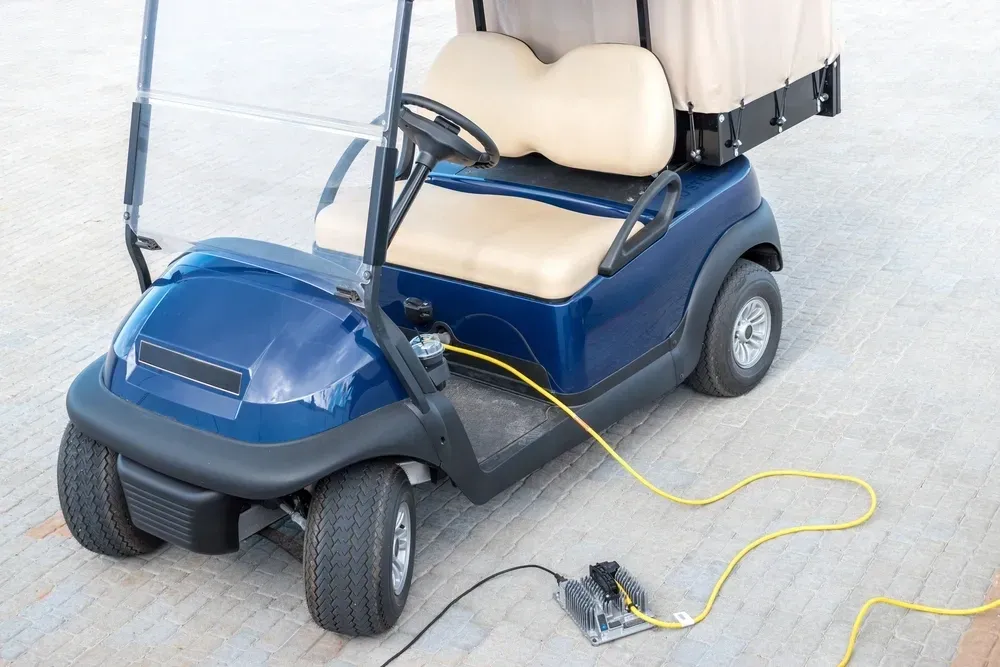
- Voltage Test: Use a voltmeter or digital multimeter if it is a secure connection. Touch the probes to the charger output cables. The reading should be 36 V as a maximum for a 36 V golf cart. It should be ~48 volts for a 48-volt system. If the output is not quite right, a different charger should be tried. This decides whether the problem lies with the charger or the battery. If the output of the cart’s charger is 0, an amperage test for more information may be needed. Ensure the charger is correctly plugged into an AC power source for proper testing, and always use the charger of your cart if it is on hand. The charger automatically cuts off (disconnects) when the batteries are fully charged to avoid overcharging and safety hazards.
- Testing with Another Cart: Try your charger on another golf cart. This helps isolate the problem. You may also apply another cart charger to your batteries. This tests your batteries’ ability to accept a charge. It is also important to identify the problem location so that the golf cart battery and golf cart battery charger operate properly in tandem and that bad connections do not compromise them due to a simple test using some spare components on hand.
- Amperage Check (Advanced): If you’re electrically inclined, check that the amps are correct. Set your multimeter to AC amps. Readings between 15 and 25 amps usually indicate good performance. However, the exact amperage can vary. Consulting the charger’s manual or a professional can help determine appropriate readings for your golf cart type.
Signs a Golf Cart Battery Charger is Faulty
Following are some symptoms of a defective golf cart charger:
No Power
The charger is functioning (lights, fan, digital readout), but the cart does not charge. Ensure you have correctly characterized how to test a golf cart battery charger, etc. Confirm pack voltage while the onboard charger is plugged in for deeper troubleshooting, in compliance with the privacy policy for all data accessed.
Overcharging
Overcharging is identified by signs such as battery acid (highly corrosive chemicals) or explosive (high gassing). It may be caused by an improper charger or other electric defects in the cart.
Extended overcharging deteriorates batteries, particularly deep-cycle batteries used in golf carts, which must be replaced over time.
Takes Too Long
When charging takes much longer than usual, the charger itself is faulty. In a Club Car electric golf cart, a deep cycle battery is typically charged to a certain time criterion. A substantial deviation indicates a problem with your battery or club car charger.
Maintaining Your Golf Cart Charger
Proper maintenance extends the life of your charger. Keep it in a cool, dry place protected from the elements, and clean it regularly to remove dust and debris.
Periodically inspect and clean battery contacts to support proper charging performance. Never forget to test the charger using the described approaches before replacing the components. Don’t unthinkingly swap your chargers or deep-cycle batteries; they might be dirty connections. Learn how to bench test a golf cart battery charger as this paper contains the steps that can be used effectively to benchmark each part or subsystem before replacing any cart chargers, golf cart batteries, or golf cart batteries. This information can be of value if ever engaging in chat rooms on an online cart forum or a wild cart community where users frequently ask, “How do you fully charge a golf cart battery? This is useful as you shall now be able to provide them with more information than before, knowing that you are now better prepared and educated with the information presented in this article.
Testing a golf cart battery charger can help ensure a healthy cart. The following testing procedure can tell whether the charger, batteries or an open connection is in trouble. Preventive maintenance is also critically important for the health and longevity of your charger and batteries. This ability gives you the power to resolve charging problems quickly and maintain your golf cart so it is always ready to play a round.
Testing a golf cart battery charger can, at least now, be a matter of course, provided you follow the following testing steps. Remember to charge the cart so that it is always fully ready. Contact us today for more guidance.